



Traditional And
Folk Songs
Kansio’y Dumaralos
Farmers’ Song
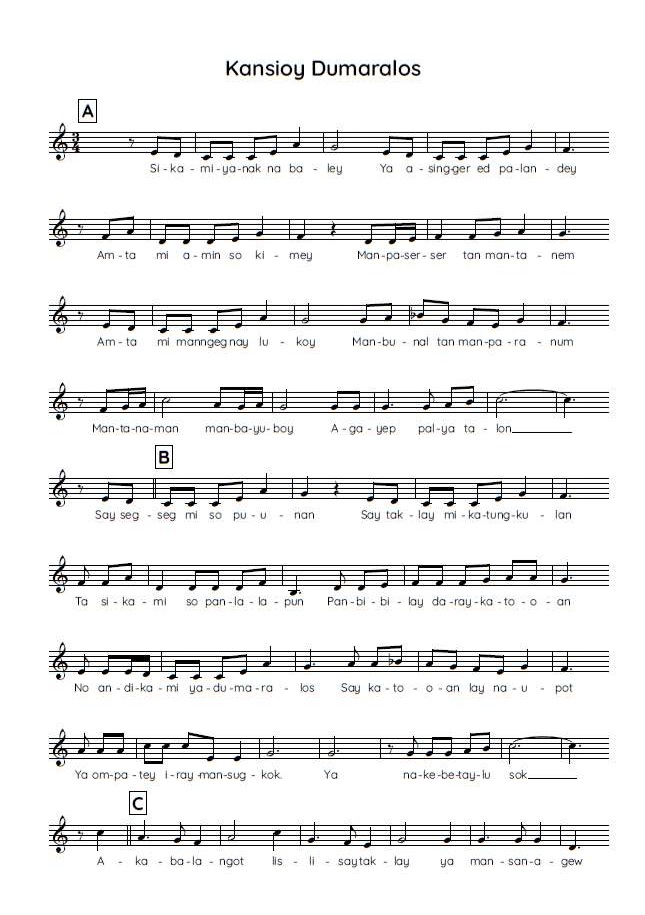
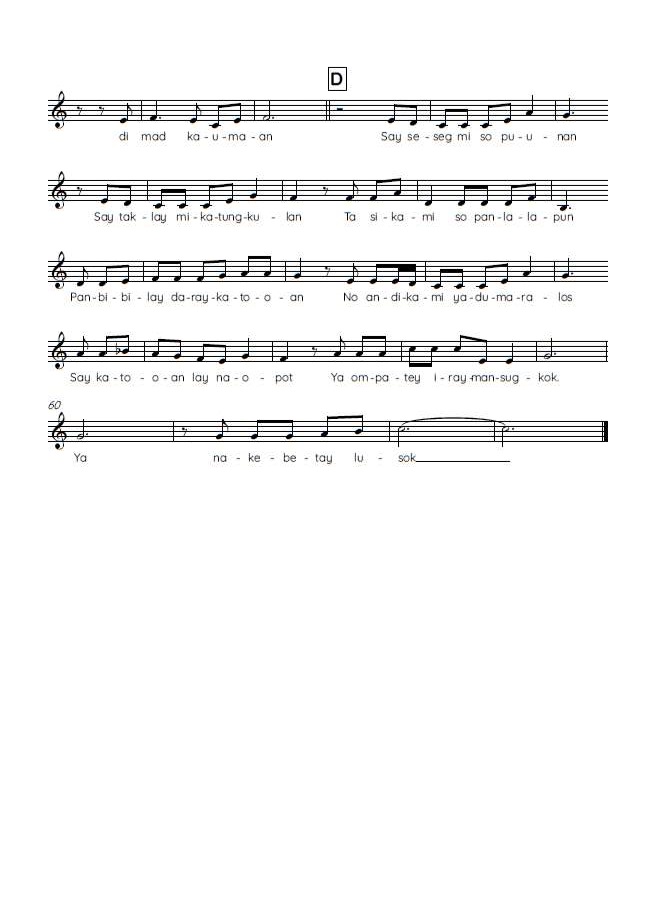
“Kansio’y Dumaralos,” is a song about farmers living near the mountains and in the barangays in Pangasinan. It tells a story of the hardships of being a farmer who stayed under the sun the whole day to plant or to harvest rice. For a farmer with hectares of rice field, he needed fellow farmers to help him.
Thus, he called for a “Gamal.” Gamal was a term for calling and requesting for help in planting or harvesting rice. The farmer calling for a gamal would prepare merienda or snacks and later, prepare a lunch for the farmers joining the gamal. During these times, some would bring a guitar and sing songs like “Kansio’y Dumaralos” and other songs that would relieve them from tiredness.
This song has 3/4 time signature with a moderate tempo. It has a C major tonality with a sol-do range. The key signature is C-Major with no modulation.
Kansio’y Sumisigay
Song ofthe Fisherman
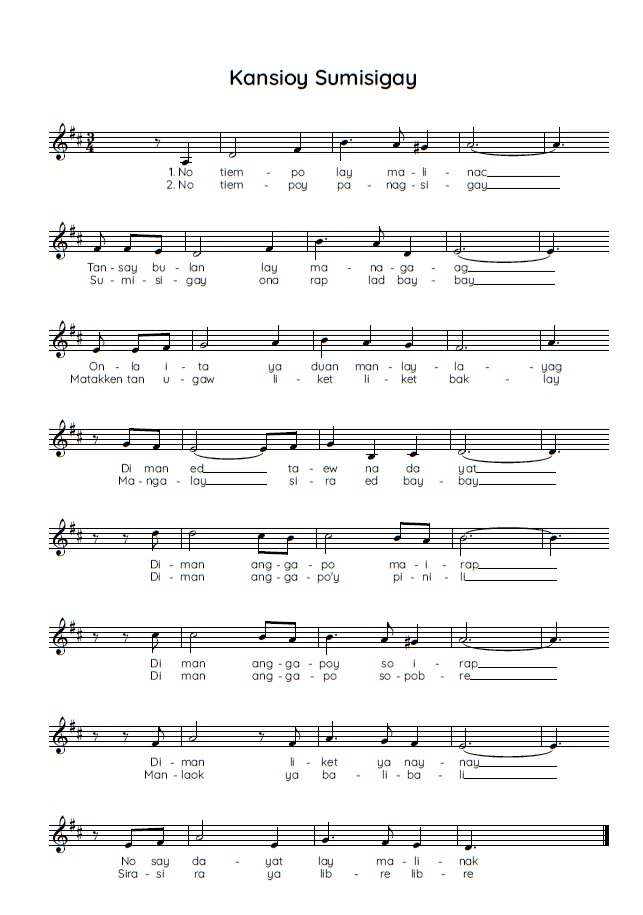
This occupational song was one of the songs found in Dr. Perla S. Nelmida’s dissertation, Pangasinan Folk Songs. While no tangible document shows where it originated, it could be surmised that this song came from the fisherfolk especially those who lived near the coastline. The towns in Pangasinan along the coast of Lingayen Gulf are: San Fabian, Dagupan City, Lingayen, Labrador, Sual, Alaminos City, Bolinao, Anda, Bani, Agno, Burgos, Dasol, and Infanta.
It is very lively with ¾ time signature with a moderate tempo. It has a rhythmic pattern. Its tonality is D Major and the range is re-do sharp. The key signature is D Major and it has no modulation.
Gali Ta Paraw La’y Unlayag
Work Song
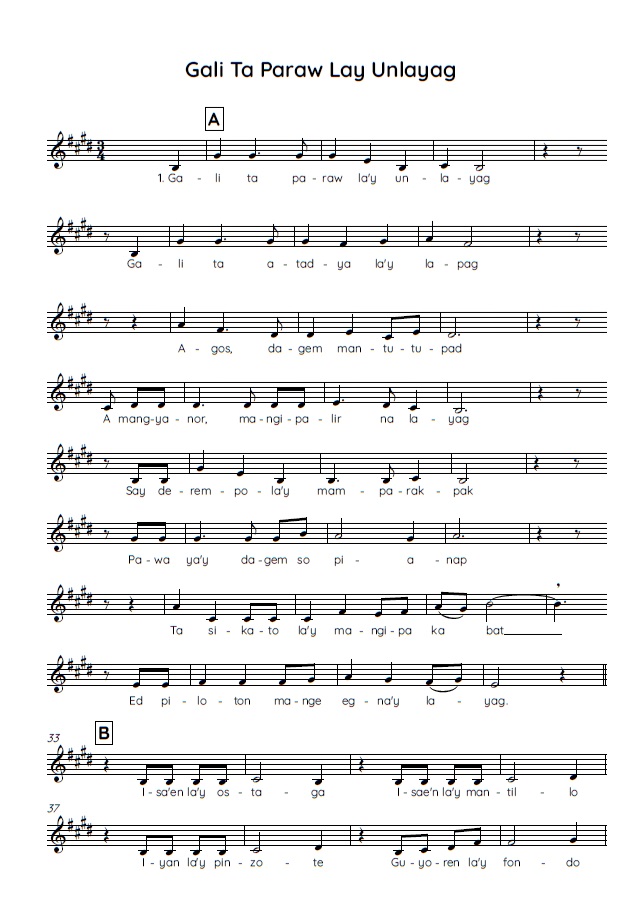
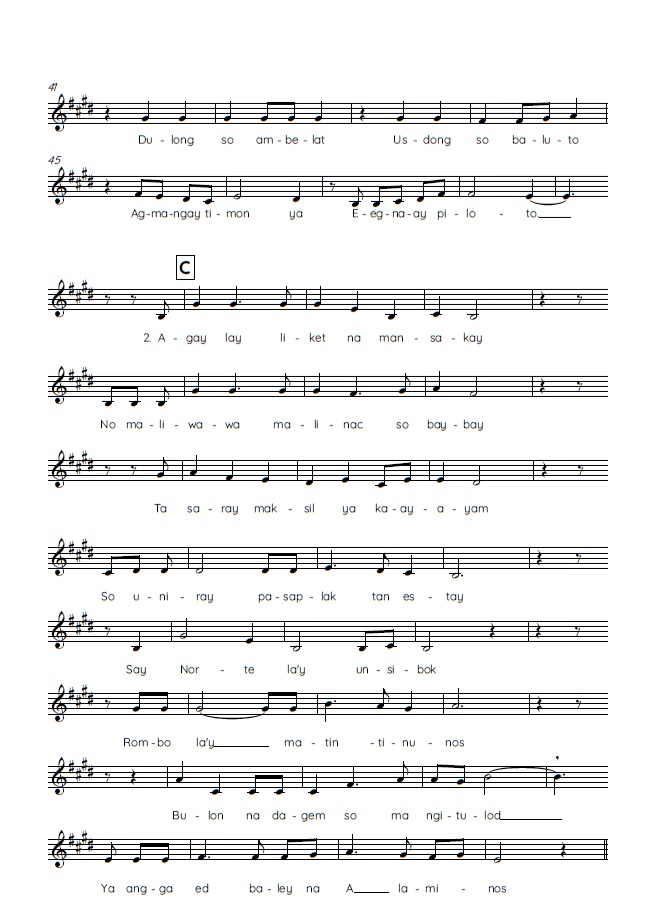
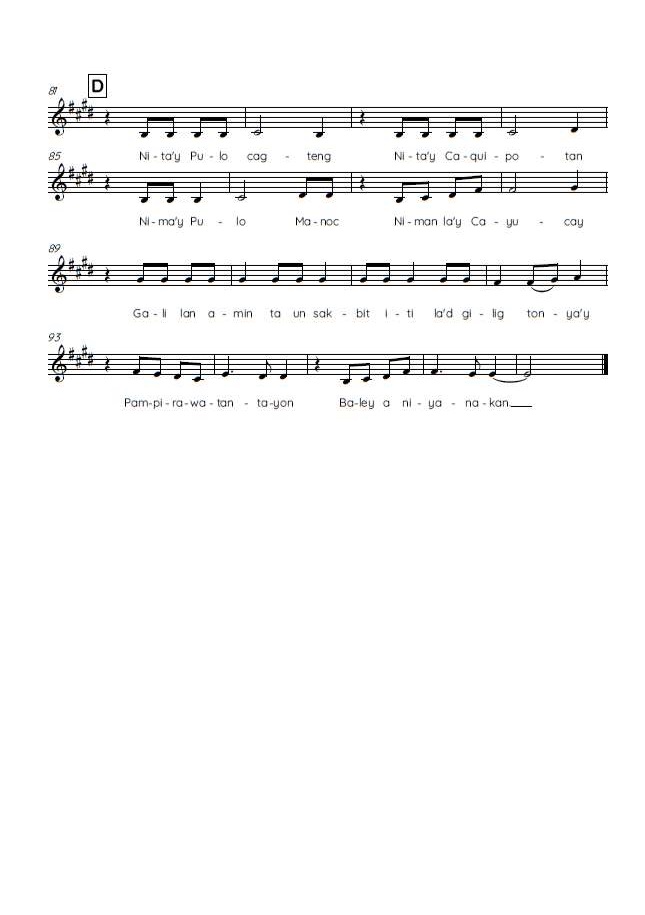
The song ‘Gali ta paraw la’y Unlayag,’ once a famous Pangasinan traditional song in Alaminos in the early part of the 20th century, was composed by Don Ramon Rodriguez and Don Marcelo Ruamero. It has a joyous tune that together with its lyrics, expresses the excited tone of the one inviting other people to join the sailing. The undulating arrangement of the melody also depicts the gentle waves of Caquipotan and Tambac Bay.
The song shows the deep knowledge of the people in operating the paraw and how keenly they observe the natural environment to take cue from when sailing is favorable. It also vividly describes the geographical landmarks that are a sight to behold as they sail to Alaminos. Lastly, the song intimates the people of Alaminos’ love for their town, conveying their longing for it in this song.
The song has a ¾ time signature and moderately fast so that could be used as a musical accompaniment during sailing or when boats need to be rowed.
Oalay Manoc Con Taraz
Songs About Nature
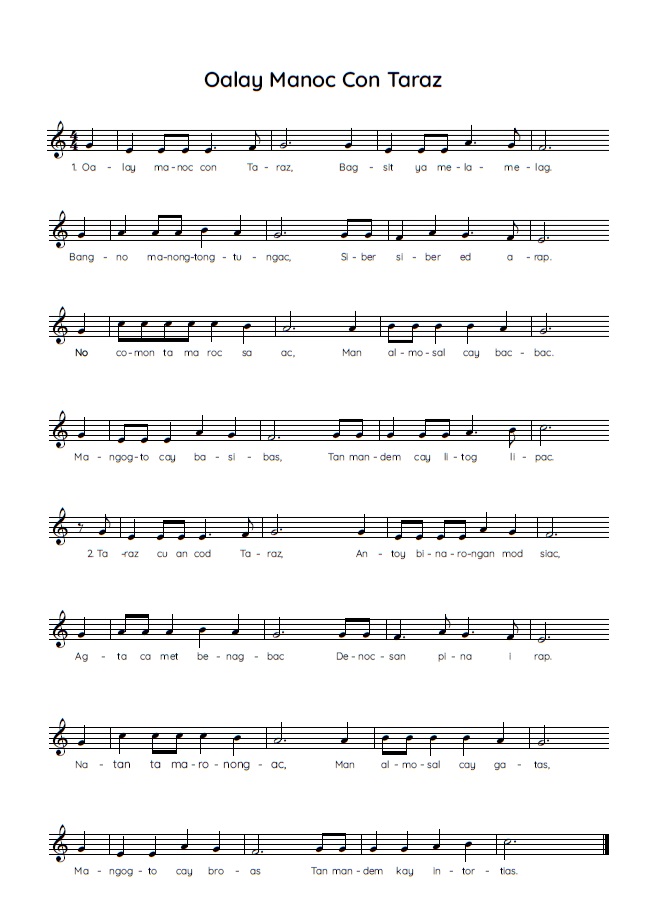
Taras is a vernacular for thrush bird. A thrush bird is a small or medium-sized bird which are mostly of a plain color with spotted underparts and many of which are excellent singers.
This song is usually sung in social gatherings as a form of entertainment and socialization. It is also sung to appease children when they become uneasy or restless.
Though the song has many versions, its rhythm and melody are constant. It has a time signature of 2/4 and has a fast and lively tempo. Its tonality is Bb major and its range is from “do” to “ti.”
Pinalapa
Songs About Nature
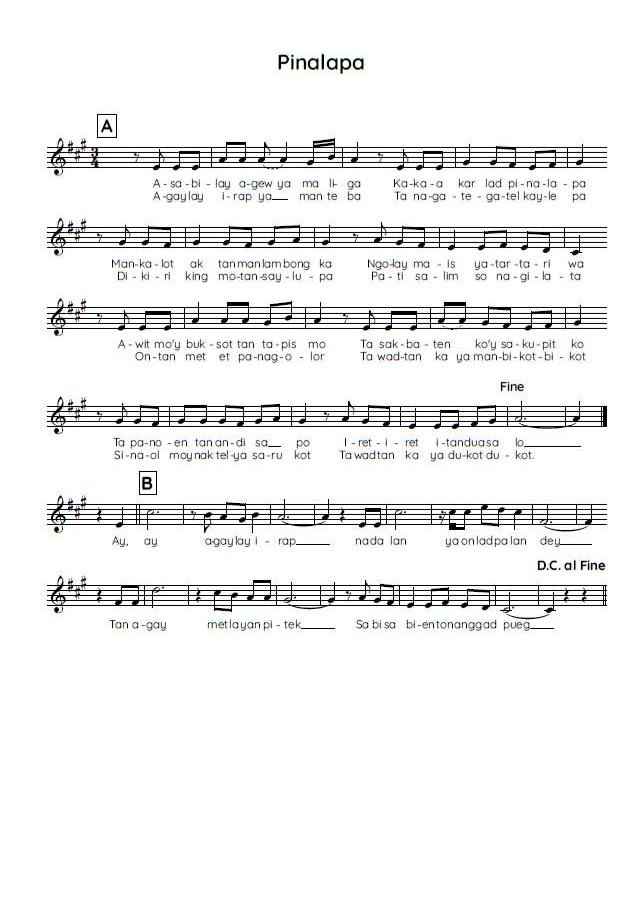
This song “Pinalapa” is sung by farmers doing slash and burn clearing technique in the mountains. Some towns in Pangasinan are near the mountains such as Labrador, Sual, Aguilar, and Mangatarem. These townspeople speak and sing in Pangasinan. It describes their difficulty in climbing the mountains which has almost knee-deep mud and ants would crawl to their faces, sides, and feet. Another difficulty they must endure is the carrying of their heavy load in going back home.
This song “Pinalapa” has a 3 4 (three four) time signature with a moderato tempo. Its tonality is C Major, and the range is do-do. There is no modulation, and it has C Major key signature.
Gozos Ed Cataoan Tin Santa Maria
Rituals/Chants (Religious Songs)
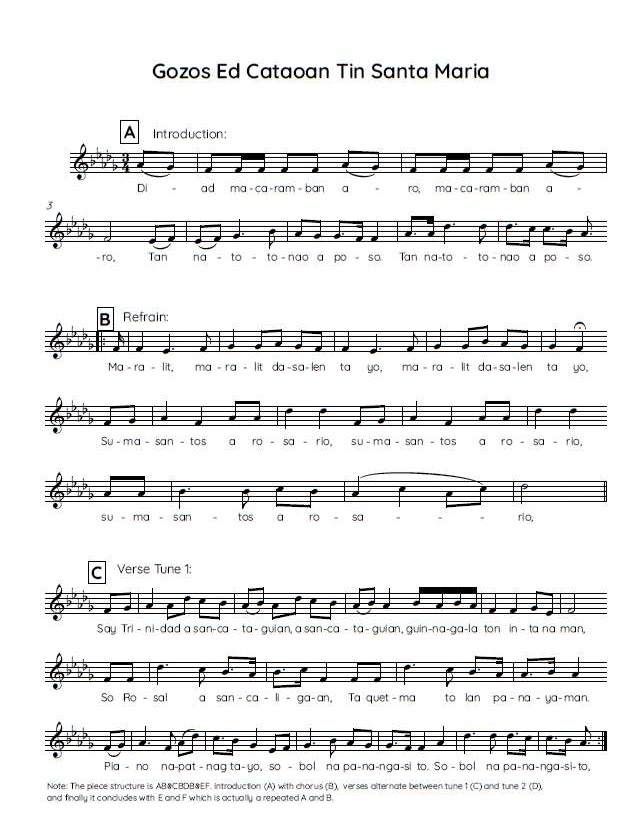
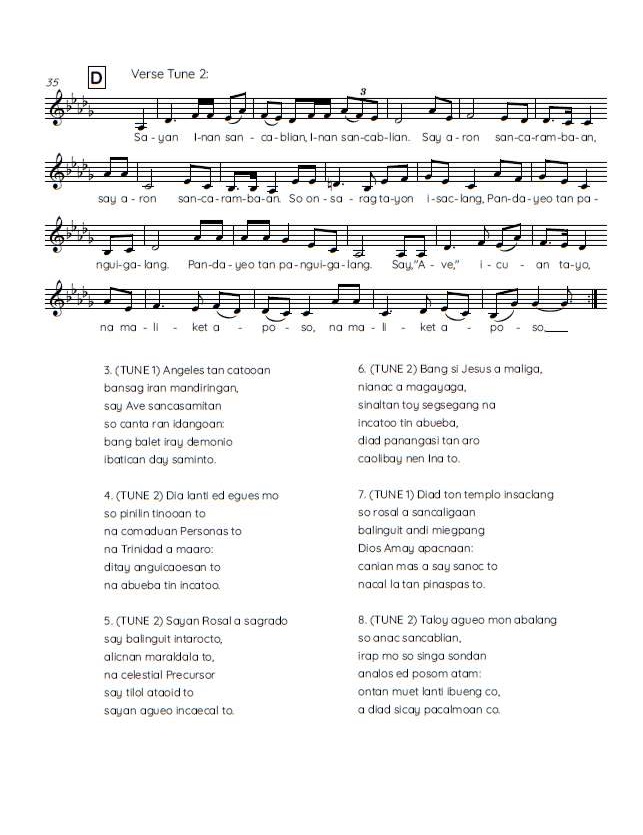
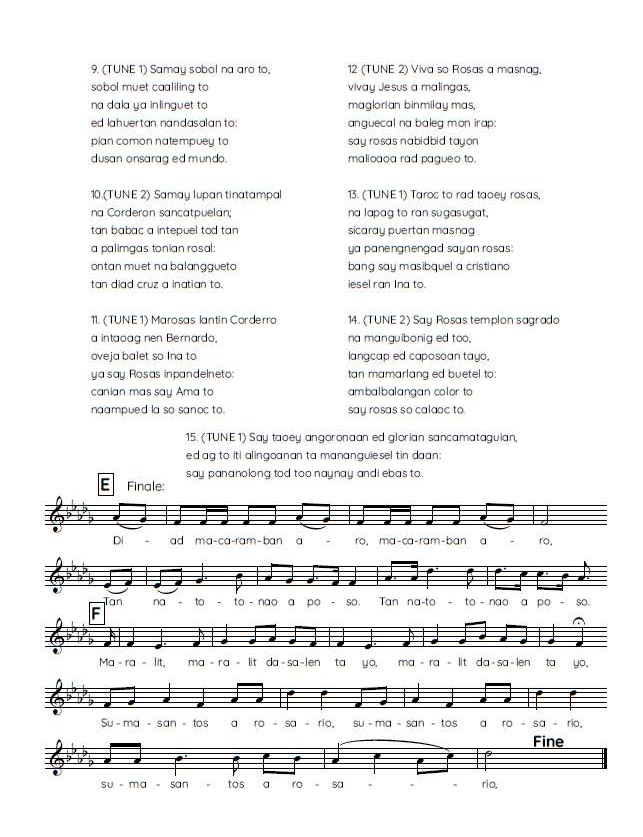
This religious song in honor of the Blessed Virgin Mary in her title as Our Lady of the Holy Rosary is called “Gozos ed Cataoan tin Santa Maria” (Song of Praise for our [lord/mother] Holy Mary) in the Pangasinan language and is sung during the nine-day novena in her honor. The folks of Barangay Polo, Alaminos City, Pangasinan hold the nine-day novena in honor of our Lady of the Holy Rosay during the month of October.
The cantores of Barangay Polo, Alaminos City sings the gozos with a distinct tune for each of the stanzas before the refrain is repeated; one for the assembly and the other for a soloist.
The song is moderately slow with a 2/4 time signature. The melody has a sweet tune that signifies the joy of praising Mary as the vessel though whom God the Father gave his Son Jesus for the salvation of the world.
Galikin
Fiestas & Celebrations
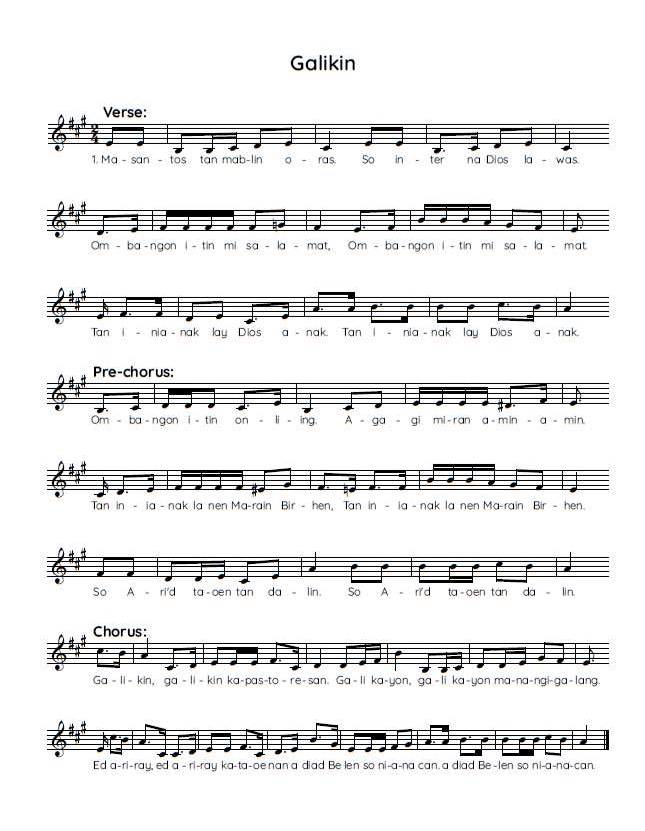
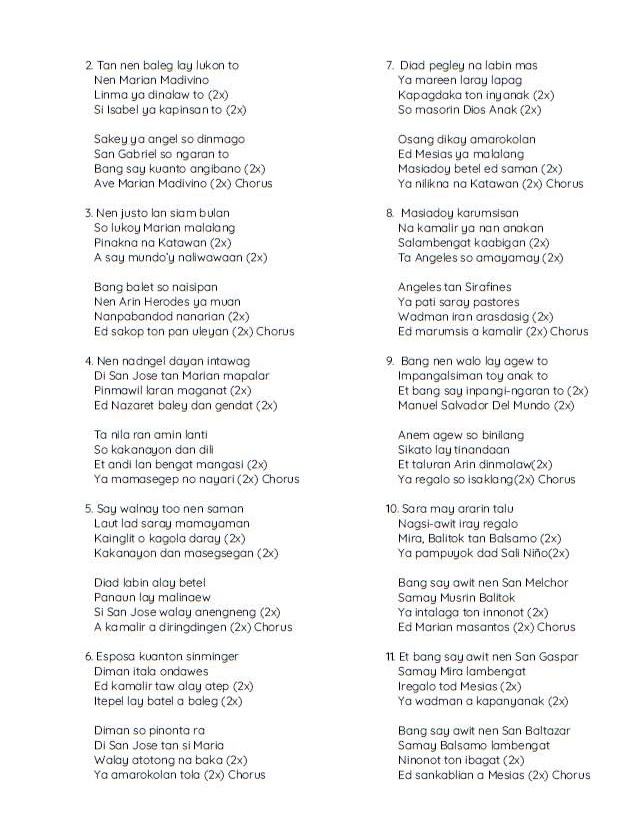
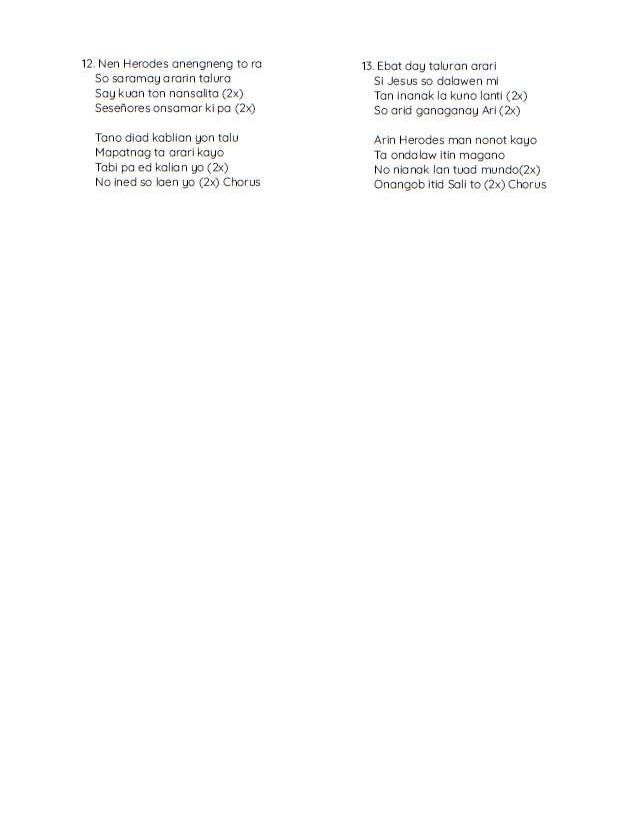
Galikin is the short version of the Aligando (Antikey ya Aligando). It is a contraction of the word Galikayo, a Pangasinan word that means “come all of you” and is addressed to the shepherds (kapastorisan). It narrates the conception of Jesus to his birth. It calls on shepherds to announce the birth of the “king of kings who was born in Bethlehem.”
It is usually sung by women in the first voice and men in the second voice. However, there are different variations of the song, three of which was arranged by Fr. Immanuel Escano.
The Galikin starts with the acknowledgment that God gives holy and precious hour (Masantos tan mablin oras so iter na Dios lawas). And that we need to arise and give thanks for the Son of God is born (Ombangon itin misalamat ta inianak lay Dios Anak). It continued to enjoin “all you our brothers” to arise and be awaken for the Virgin Mary has given birth to the King of heaven and earth (Ombangon itin onliing, agagi miran amin-amin, ta inianak la nen Marian Virgen so arid tawen tan dalin).
Then it calls on the shepherds to “come and adore the King of heavens who was born in a manger” (Galikin kapastorisan, gali kayon mangigalang ed Ari ray katawenan diad Belen so nianakan). This stanza constitute the refrain of the song.
The song continues to narrate the conception of Mary, the birth of Jesus and ends with the visit of the Three Kings.
Inter na Dios
Fiestas & Celebrations
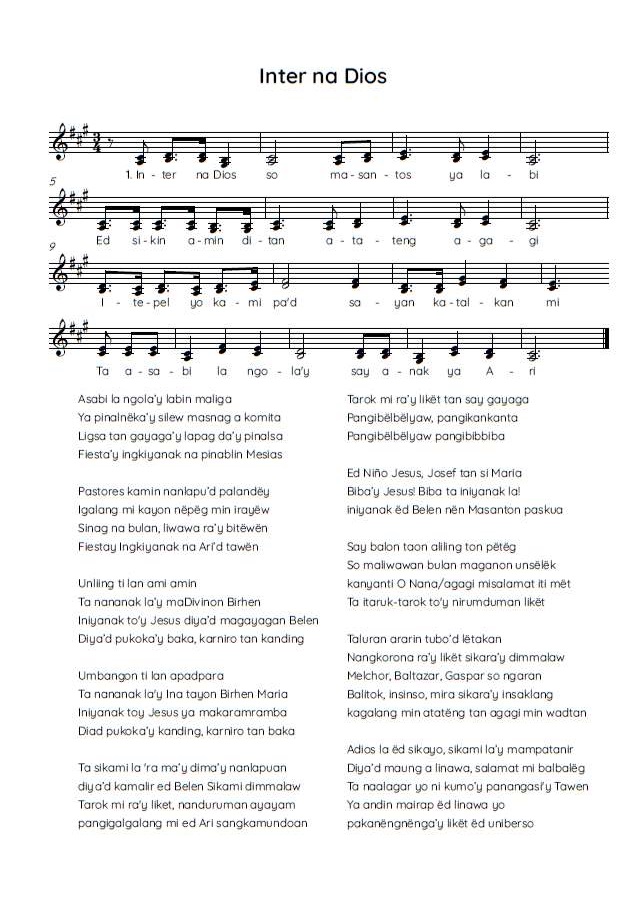
This traditional Christmas song in Pangasinan language was believed to be composed by “Laki Aryon” (Grandfather Aryon) Hilarion De Leon of Alaminos City, Pangasinan, who lived at the close of the 19th century up to the early 1900’s. Currently, this traditional Christmas song is known to be sung in the City of Alaminos and in the municipality of Lingayen. Its music is reminiscent of the gentle yet joyous night of Christmas when, in the cold of night, the shepherd went to adore the newly born Jesus in the manger, as the song’s lyrics so narrates.
The Christmas song is usually sung by a primera and segunda even though there are many singers during caroling. The singers of Amandiego know how to harmonize the song so that it has been never heard that it is sung in unison. It is also a must that a guitar accompanies the singers so as to enhance the beauty of the song. More often, the owners of the houses that the carolers sing for participate in the singing and dancing, as the singers usually sway while singing and some participants dance the balse. Sometime an improvised drum made of a plastic container is used. In the olden days actual drum was used to maintain the beat of the song.
The beauty of the song lies in the exact combination of the lyrics and the melody of the song that makes it sweet to the ears even though it has a broken ¾ time signature.
Deyeng Da’y Rosrosas
Fiestas & Celebrations
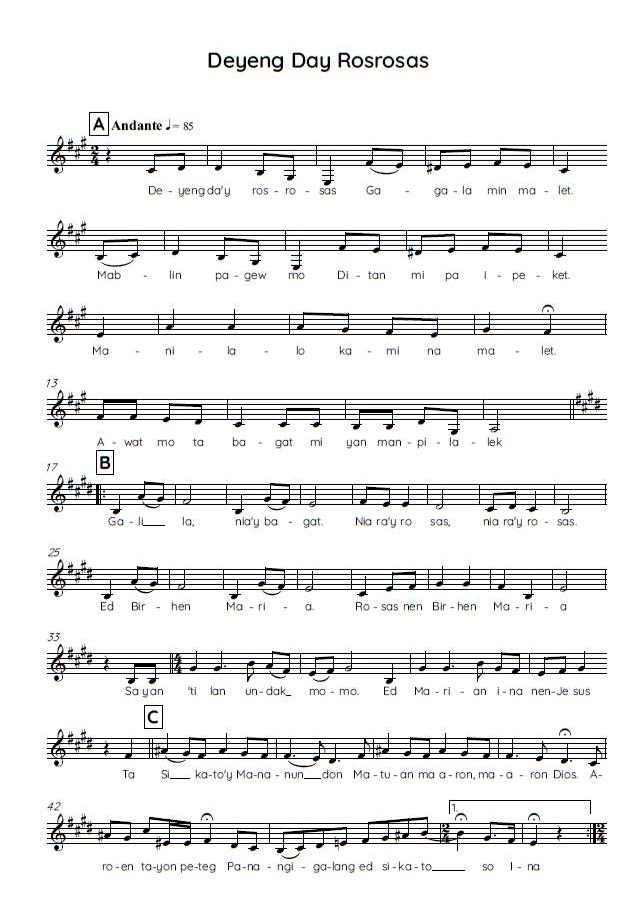
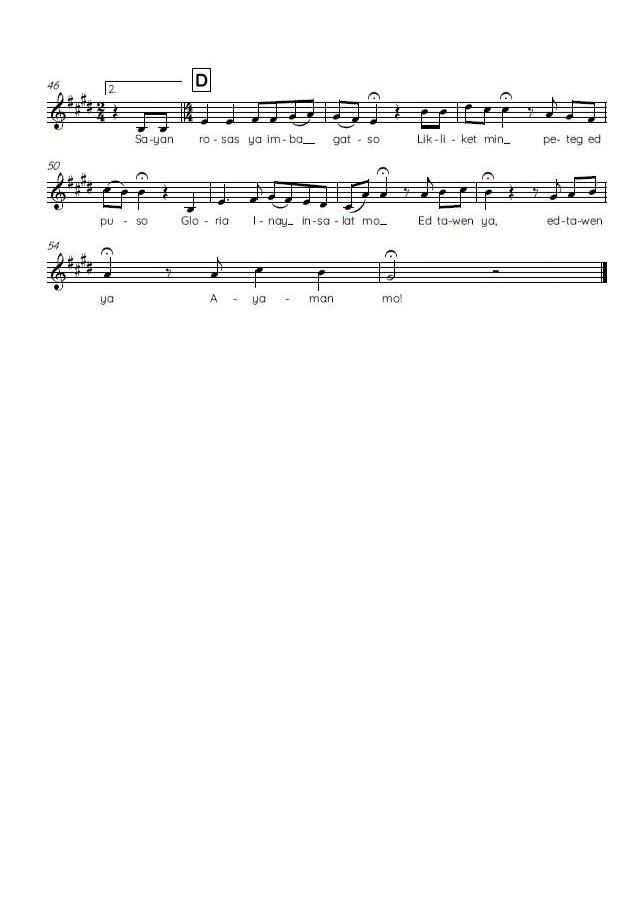
The Deyeng da’y Rosrosas (Flowers sewn Together) is a religious ritual song that is sung during the floral offering to the Blessed Virgin Mary specially in the month of May. Before beautiful, fragrant, or colorful flowers are offered to the image of the Virgin, a leader of the cantores intones the song then she/he is joined by the rest of the cantores and the participants.
The actual floral offering is done upon the repeat of the refrain “gali la niay bagat, nia ra’y rosas, nia ra’y rosas ed Birhen Maria, rosas nen Birhen Maria.” (Let us go, here is our offering Here are the flowers, here are the flowers For the Virgin Mary, flowers of the Virgin Mary). If there are many offerors, it is necessary that the refrain is repeated until all the flowers are offered. No specific kind of flowers are offered as long as it is beautiful, colorful or fragrant. Then the last stanza is solemnly sung with prayerful mood “Sayan rosas ya imbagat so likliket min peteg ed puso, gloria Ina’y isalat mo.” (These flowers offered are tokens of deepest joy in our hearts, mother may this be rewarded with glory In heaven, in heaven Your abode). With a guitar as accompaniment, this ritual song is still sung by the cantores of Amandiego during the Flores de Mayo celebration.
The song has a moderately slow 4/4 time signature, however, it has some parts that seem to be chanted. The melody of the song has a sweet solemn tone
Pagatin
Courtship and Marriage
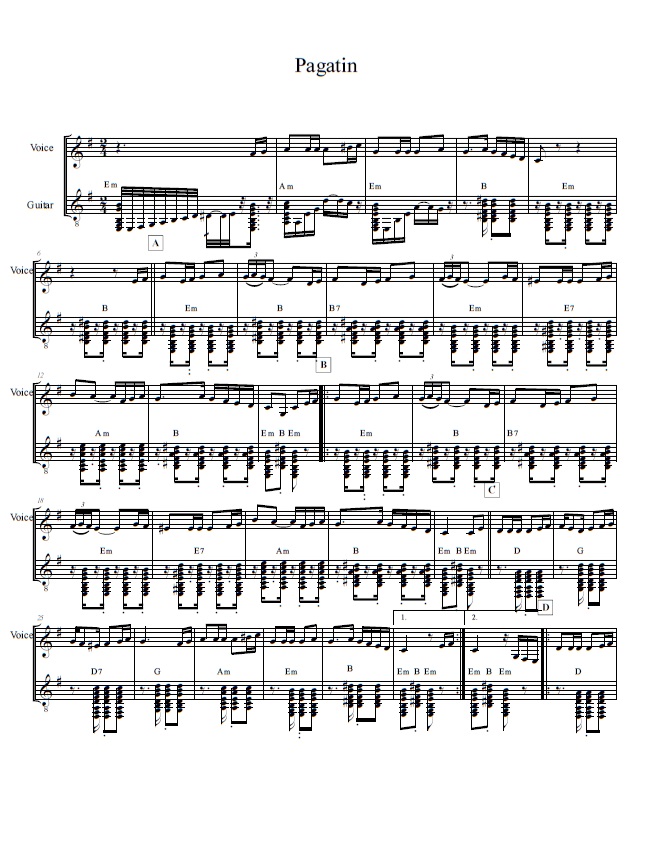
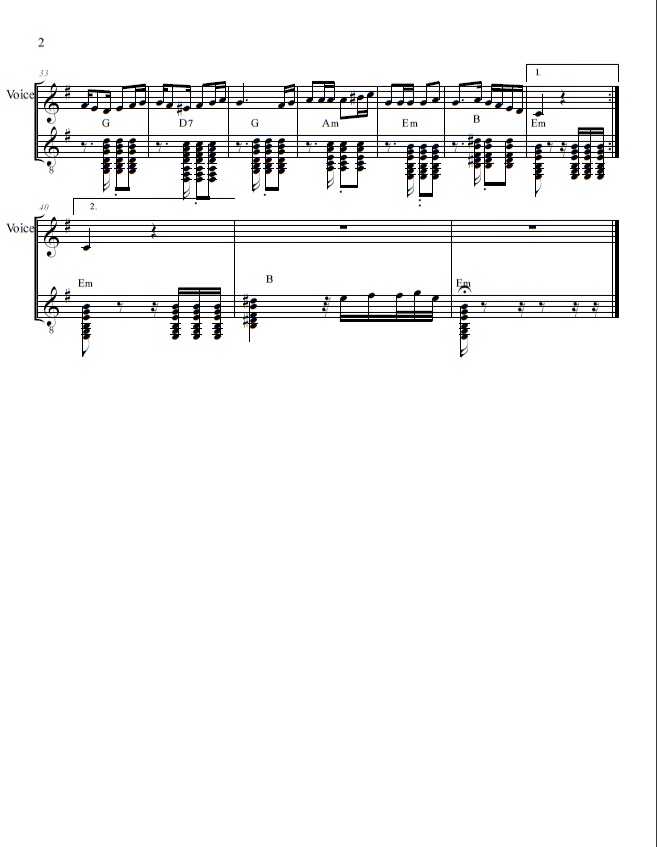
Pagatin is a kind of Pangasinan wedding song. It is derived from the word gatin which means to “to tread or step on.” It is a song that recounts the bride’s entry into the groom’s house.
The song Pagatin is sung by the groom’s mother after the wedding reception which is held at the bride’s house. The bridal entourage goes to the groom’s house where a simple reception awaits them.
The Pagatin tells about the encouragement of the groom’s mother to the parents of the bride to do what is necessary because both of their children are in need. The groom’s mother manifests her true love to her daughter-in-law by meeting her, dancing for her, and asking her to sit by her side.
It also conveys the desire of the mother to make the union of their hearts a priority—and that they may have faithful love now and forever—that their hearts may be committed and beat as one—and that they may help one another so that they will prosper in life.
The song has a time signature of 2/4. Its tonality and key signature is C minor. And it range is from “do” to “ do.” Its tempo is slow but it can be adjusted to moderato or allegretto.
Malinac Lay Labi
Courtship and Marriage
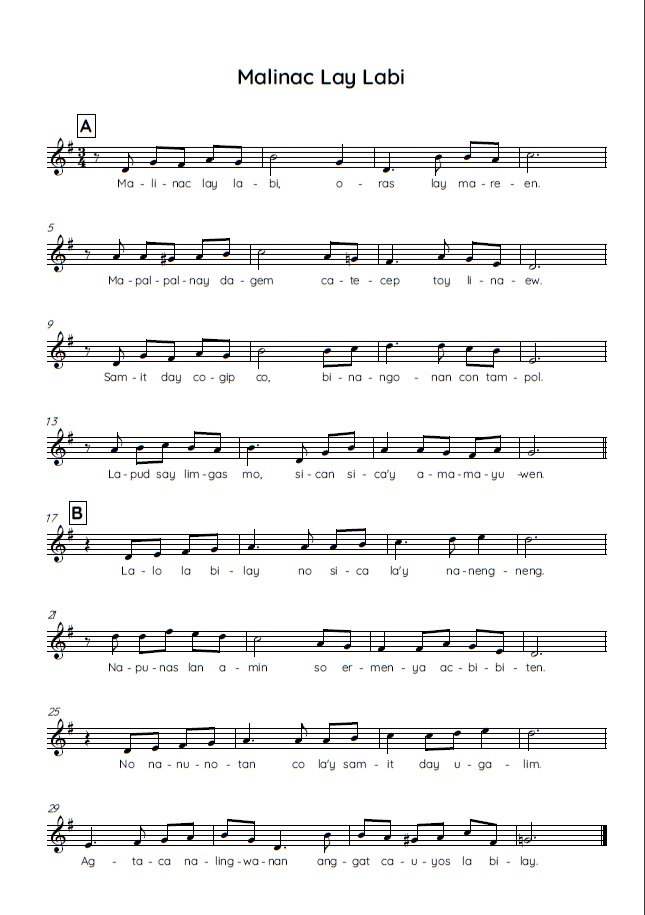
This song is an undying song of the Pangasinenses. It is sung by almost all Pangasinenses wherever they are. It is not only sung in serenading or wooing a lady love but is also sung during various occasions like birthday parties, formal or informal programs, conventions, reunions, and many other occasions. This song is said to be the “theme song” of Pangasinenses for whatever they are, young and old, men and women, whether here and abroad, they sing this song.
This song tells how a lover dreamed sweetly of his ladylove in the stillness of the night. He expresses his feelings very romantically, telling her how he adored her beauty, how she makes his lonely and boring life happy, that her beauty is something to behold and to cherish until his last breath.
This song has a time signature of 3/4 and with a moderate tempo. It is in the key of F Major. Its range is do-re. It has rhythmic pattern but no modulation. Its tonality is F Major.
Buracan
Courtship and Marriage
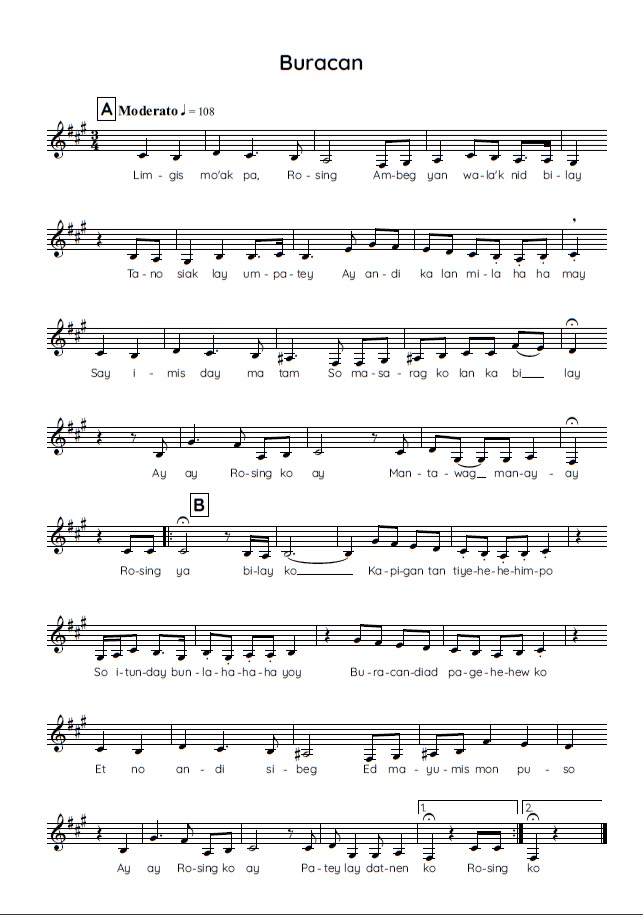
This song is a love song which expresses the undying love of a man to a woman, Rosing. Rosing is the generic name for Pangasinan women. He wanted the attention of his lady love, while he is still alive. He said that when he dies, she could not go to his wake. Her glance could make him live. He moaned and called his lady love for he was in pain.
Metaphorically he compared his heartbeats like that of the sea waves roaring with nervousness. He said that Rosing is his life. He was asking when the time would be his heartbeats would stop roaring. If Rosing would not pity his begging heart, he would rather die.
The man’s feelings are hurting for his love was not being reciprocated. His heart beats fast like that of the sea waves rushing to kiss the shores every time he glances at her. He was pleading Rosing to pity him and answer him positively. He was very desperate to make his love be granted with the same love he was offering to Rosing.
The song has a 3/4 time signature with a moderato tempo. It also features a F-sharp major key signature.
Dampay
Courtship and Marriage
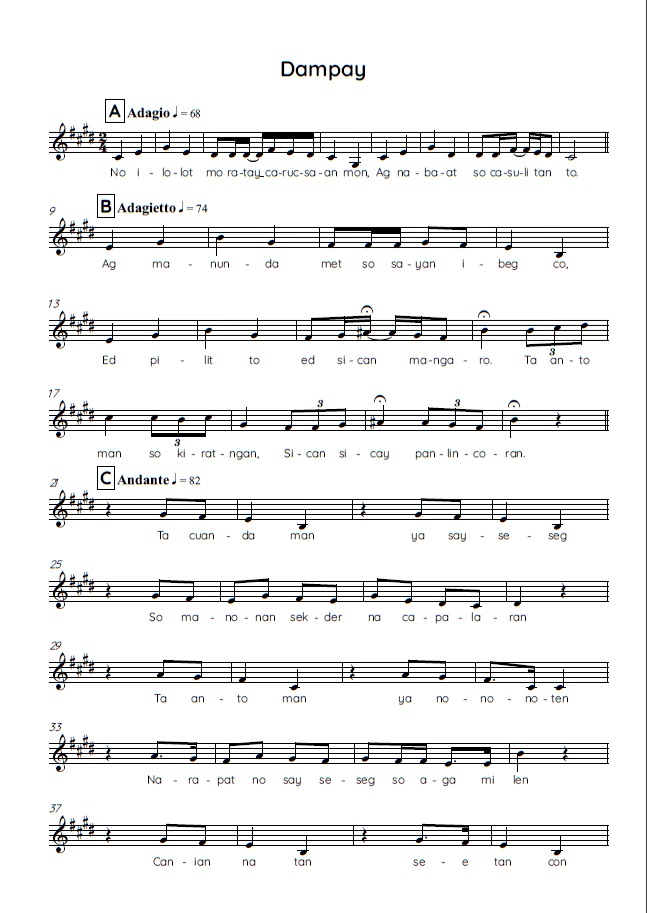
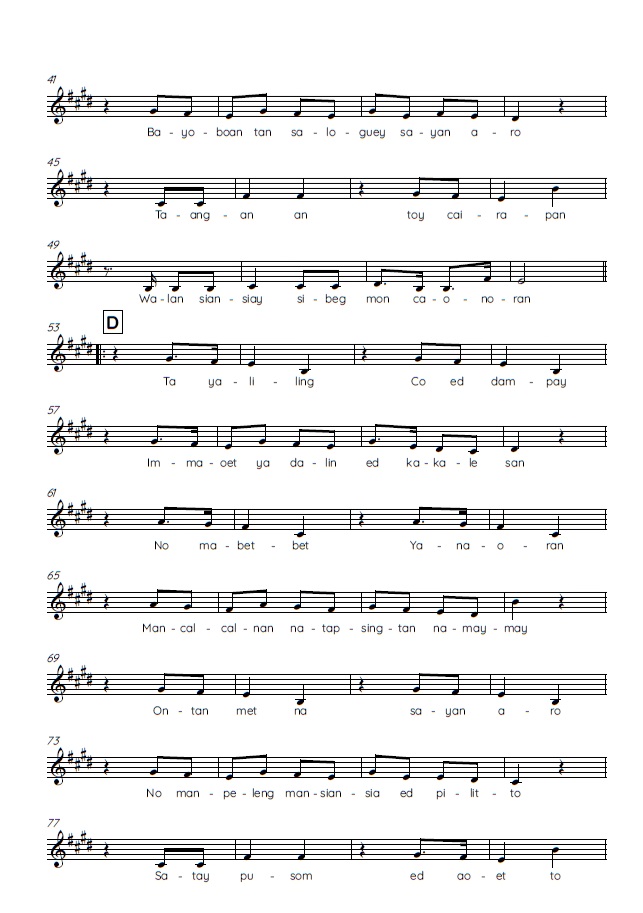
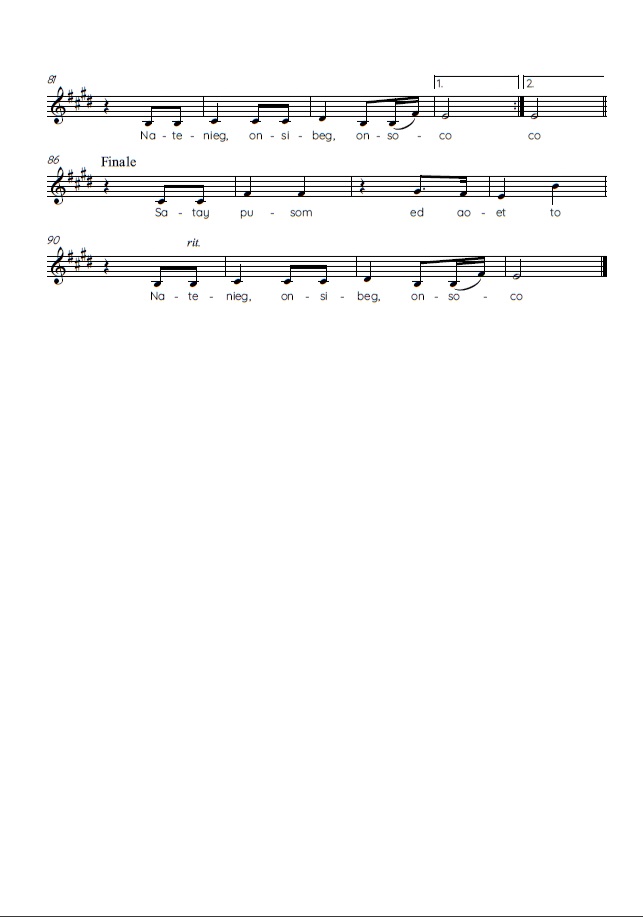
Dampay (Hardened Clay Rock), composed by Pedro Braganza, Sr., is a traditional love song in Alaminos City, Pangasinan. It is sung by men who express their persistent love despite seemingly unsurmountable odd in obtaining the love of a lady, the object of their affection.
The two-stanza chorus tells the hope of the man who by perseverance in loving and serving his beloved lady, the latter will eventually fall for him. The of love the woman is likened to a hardened clay rock on the mountain sides; very hard but with the constant rain, it will slowly soften and crumbles. The persistent love of the man is likened to the continuous rain that softens the ‘dampay.’ Eventually because of the perseverance of the man, the woman finally surrenders her love to him.
It has a 2/4 time signature and is moderately slow. . The song starts in the minor key with somewhat morose and subtly agitated tune relaying the emotion of the man whose object of love does not respond or continues to reject him. As the song reaches the chorus, it shifts to the major key and the tone turns to a hopeful disposition
No Siac So Mangaro
Courtship and Marriage
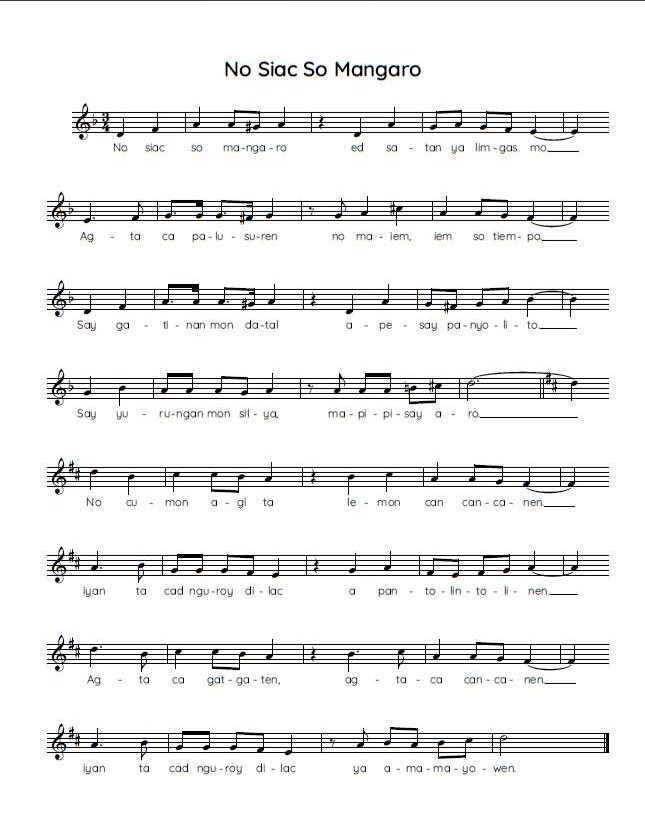
No Siak So Mangaro is a traditional community song that is oftentimes sung in various events by both young and old. It is so popular that it ranks next to Malinak Lay Labi—and probably more popular than Walay Manok Kon Taras.
It is categorized as a love song that depicts how a typical Pangasinan lad can genuinely love a maiden. It is an allegorical expression of how a would-be husband can truly love his would-be wife in a very creative way. The lover offers his sincere love to that point that he would even spread a handkerchief to the floor that his lover will step on.
The song has ¾ signature and is moderately fast. It has the beat of a waltz; hence, danceable. It has a tonality of Cm / C Major and a range from Do to Do. The song Is better sung with the accompaniment of a guitar.
Oguip Ka La Inong
Sleep My Son
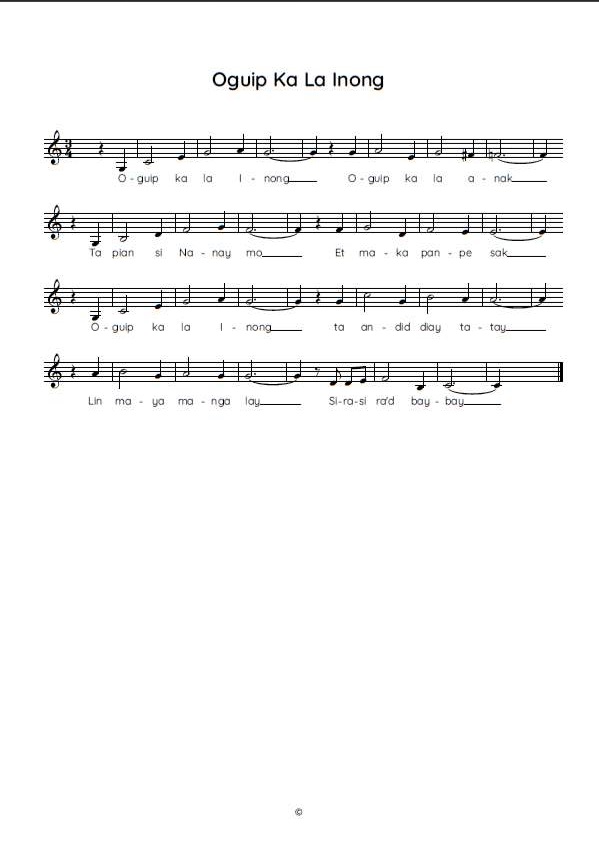
This is a cradle song that enables the baby to calm down, relax and eventually fall sleep so that the mother could do the laundry. It portrays the usual setting in the coastal towns of Pangasinan where the mother takes care of the baby and the father goes fishing in the sea to provide sustenance for the family.
It insinuates that the father also takes turn in caring for the baby especially when he is not out in the sea because the song says, “Go to sleep my son for father is not here. He went to catch fish in the sea.”
The song has a 2/4 time signature and in the key of C Major.
Garaw Garaw
Bolinao Songs
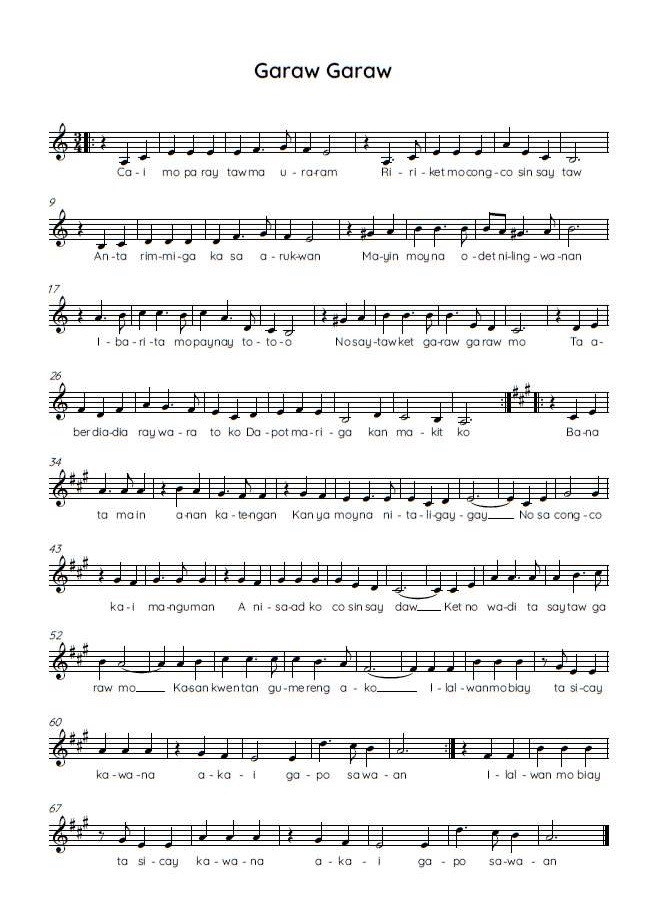
The traditional song “Garaw-garaw” of the people of Bolinao is a song of love by a man who seem to think that the woman of his affection considered the love that they enjoyed in the past was just a game. The man continues to say that even though the woman would forget the happiness brought by their love in the past, he will remain loyal, and, if forgetting their love causes her joy, the man would let her that way.
The song has a 3/4 time signature and is moderately slow. It starts with minor chords and a melody that sounds sorrowful, very apt for the wordings of the that expresses regret of a love considered a plaything. Then, the chords shift to major at it accompany the accepting seemingly fatalistic message of the lyrics; typical of a lover who accepts his fate despite the object of his love being happy in the arms of another.
Burak A Mariga
Bolinao Songs
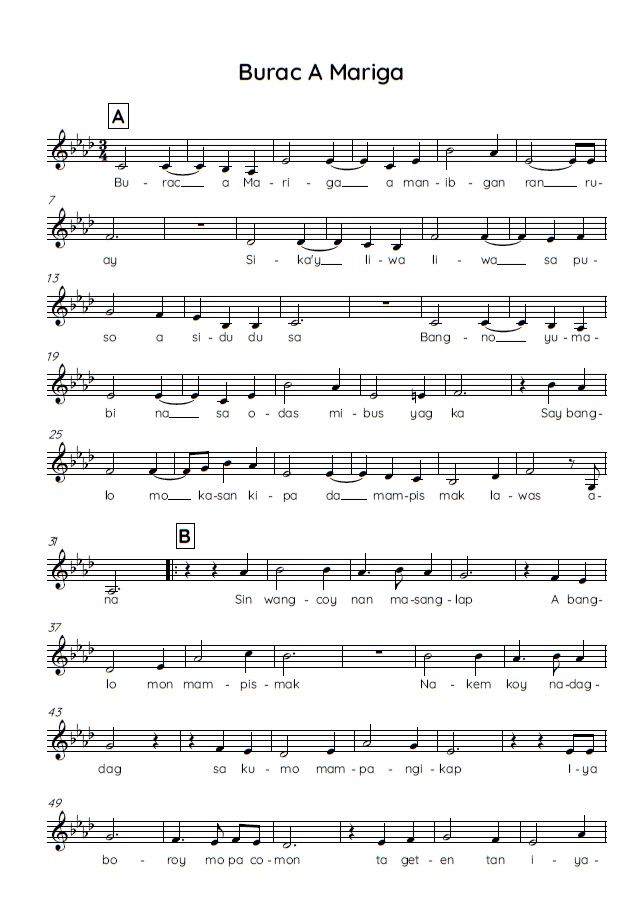
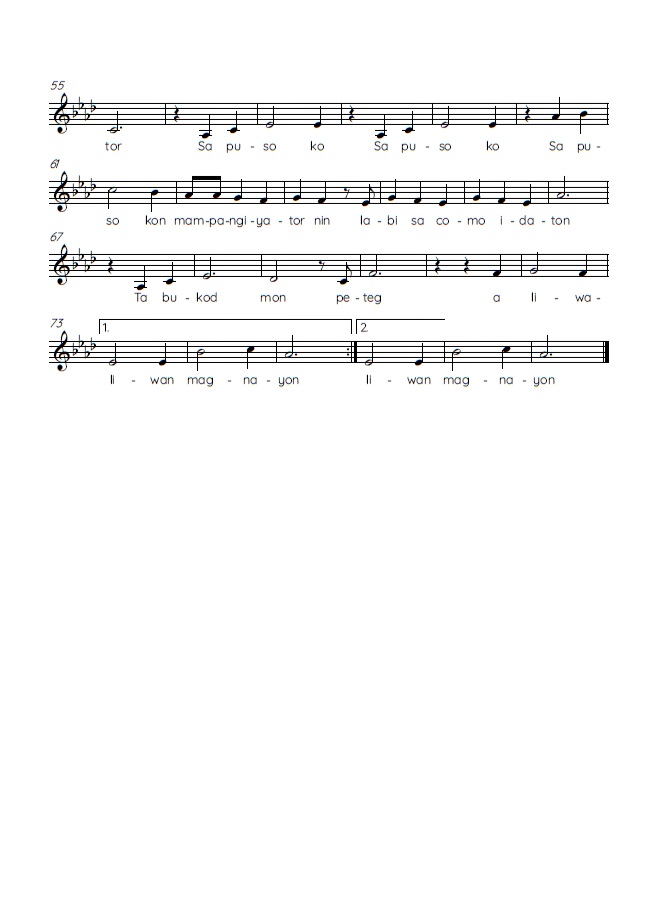
The traditional song “Burak a Mariga” of the people of Bolinao was said to be a composition of the De Perios, one of the families that belong to the principalias of Bolinao. The song is a serenade or a Patben that is sung in the evening in front of the house of a lady to express the love or admiration of a young man. It can also be sung during gatherings and festive occasions.
Literally, the title means ‘Happy Flower’ but is a figure of speech to mean a beautiful woman who attracts men and is the cause of their joy. The song speaks of man’s enchantment of a flower, albeit, a beautiful woman, which causes happiness. It is the wish of the man that this lady be his lover forever.
The song has a 3/4 time signature and is moderately fast. It has a danceable beat that can accompany a swaying singer to enhance his singing.
Inado Nan Puso
Bolinao Songs
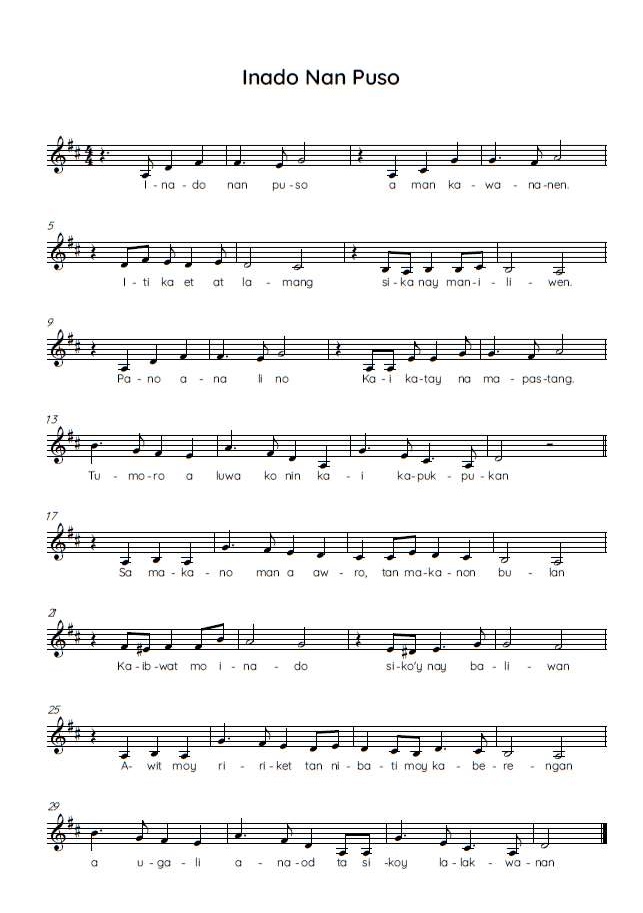
The song “Inado nan Puso” is a traditional love song in Bolinao, Pangasinan. It is a typical love song that expresses sorrow and longing for the beloved who goes away, leaving the lover distraught.
This song is also a “patben” or a serenade song to draw particular attention of the object of affection and is sung in front of a lady’s house in the evening or night.
It has a 4/4 time signature and is moderately slow. The melody is sweet and nostalgic, very apt for the lyrics which express the grieving heart of a man left by his beloved.
Bituen a Maslag
Bolinao Songs
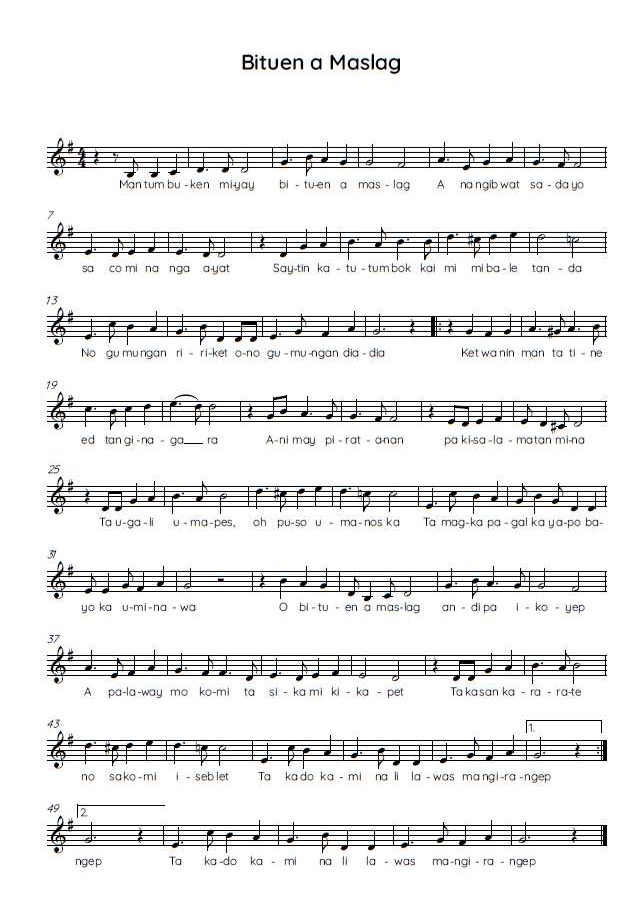
The song “Bituen a Maslag” (Bright Star) was believed to be composed as one of the De Perios, that belong to the principalias of Bolinao. The song is a “patben” a serenade that is usually sung by young men in the evening in front of the house of a lady of their affection but may also be sung during gatherings and festive occasions.
One can glean from the lyrics that the object of affection is likened to a bright star by men who were captivated by the beauty of a lady. They made a journey to the house of the lady perchance they will be entertained and not reject. The song also shows the poetic expressions of the Zambal-Bolinao men in articulating their love; their fatalistic yet hopeful attitude, perhaps the lady of their desire reciprocates their love.
The song has a 4/4 time signature and is moderately slow. It has a sweet, captivating melody that suits the hopeful plea for attention of a lady as an object of affection by a lover